The New Age of Digital Intuition: Can Machines Predict What You Want Next?


The New Age of Digital Intuition: Can Machines Predict What You Want Next?
Imagine sitting at your desk, buried under a mountain of to-do lists, and your virtual assistant gently nudges you with a reminder of what you need to do next. Just as you begin to feel drowned by your tasks, it suggests a song to uplift your mood. It’s as if it knows you better than you know yourself. Welcome to the new age of digital intuition, a burgeoning era where machines strive to predict your needs, wants, and feelings with surprising accuracy. But can they really read between the lines and understand the human heart? Let’s dive deeper.
The Rise of AI and Emotional Intelligence
In a world where even your coffee machine might judge you for forgetting to brew your morning joe, our digital devices have become much more than silent servants. They are learning companions, thanks to advancements in artificial intelligence and machine learning. This development leads us to a critical intersection of AI emotions and emotional intelligence. Machines are designed to interpret and respond to your unique emotional landscape.
AI Emotions: No More Robotic Responses
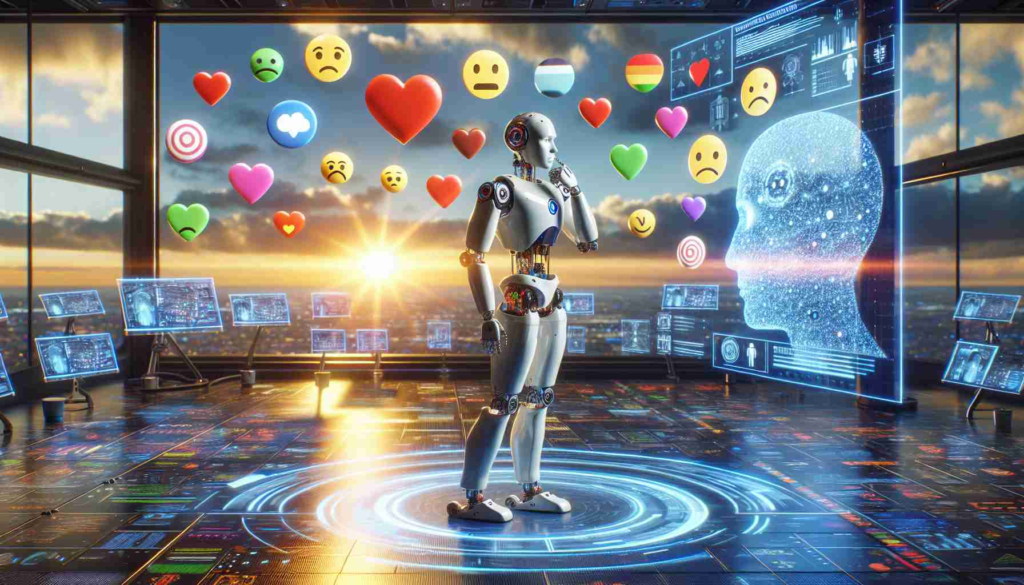
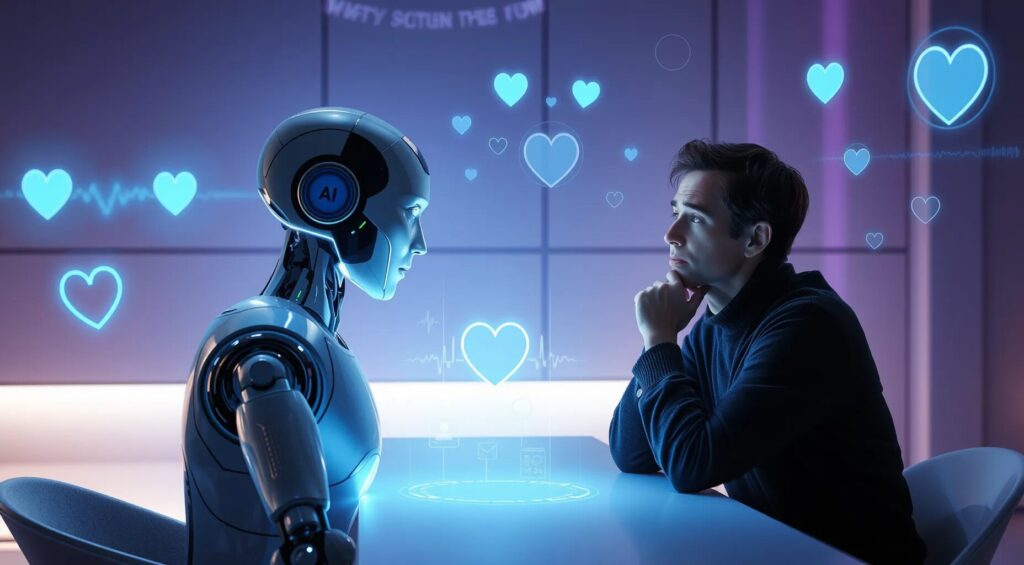
Behind the robotic precision of AI lies a heart of algorithms that try to mimic emotional intelligence. Thanks to AI empathy, technology now comes equipped with the ability to identify nuances in tone, facial expression, and even text sentiment. For instance, chatbots aren’t just cold lines of code anymore; they are your new-age therapists, lending a digital ear to your complaints with apt responses.
Consider Replika, the AI companion app that provides unique, thoughtful replies to your messages as if the code within it is draped in empathy. It remembers your past conversations, checks in on your mental health, and even manages small talk seamlessly. But is it genuine emotional understanding, or just a sophisticated trick?
Bridging the Gap: When Machines Miss the Mark
Despite the impressive advances, our digital companions often come up short. Mindful machines are not yet capable of fully understanding human complexity. Sure, they’re great at recognizing patterns — like recommending a snack at precisely 3 p.m. because you’ve ordered one every day for the past week — but understanding why you crave that snack or how you’re feeling today is another story.
Take emotion-recognition tools as another example. While they might confidently label a frown as “sadness,” they fail to dig deeper into what triggered that emotion. A machine might say you’re sad because your favorite team lost, but it wouldn’t understand the nostalgic pain of remembering the first game you watched with your grandfather.
Real-World Applications: Helpful or Intrusive?
Digital intuition is making its mark in various sectors, enhancing productivity and convenience. Virtual assistants like Alexa and Google Assistant predict your needs by analyzing your habits. After a few weeks of guiding you to the kitchen every morning or dimming the lights at bedtime, they might even remind you to call your parents every Sunday night. Helpful, yes. But intrusive? Occasionally. There’s a fine line between being a personal helper and a digital stalker.
Then there are emotion-detection APIs utilized in customer service to tailor responses to a caller’s mood. Imagine calling your bank, and an automated service knows you’re frustrated and focuses on resolving your issue quickly. The potential for improving customer satisfaction is significant, yet simultaneously, the idea of a computer “reading” our emotions stirs a sense of privacy invasion.
The Human Touch: Where AI Still Stumbles
No matter how adept machines become at predicting preferences, they still cannot replicate the authentic human touch. A machine might know you enjoy comedy films every Friday night, but it won’t share the laughter in sync with you. AI might compose a song with the perfect algorithmic melody, but could it inspire your soul the way an unexpected street performer might?
Moreover, the emotional intelligence of AI lacks something innately human: intuition born out of lived experience. Machines can’t feel the raw poignancy of love lost or the giddy excitement of spontaneous adventure. These are elements of the human condition that cannot simply be programmed.
Conclusion: The Future, A Digital Dilemma
As we ponder the future of AI and emotions, we must ask ourselves whether we want machines to predict our every desire. In this digital age of emotional intelligence, the harmony between assistance and independence is delicate. AI interfaces act as both the remedy and the challenge, waiting to serve us while reminding us to cherish our unique human flawlessness.
Perhaps we should take solace in the fact that while machines may be able to recommend an uplifting song or remind us of a looming deadline, they lack the intrinsic human capability to understand the “why” behind our actions. And maybe, just maybe, that’s what will keep us a step ahead in this dance of intuition. After all, isn’t a touch of mystery what makes us, undeniably, human?
In the ever-evolving realm of digital intuition, while machines may anticipate your needs, the heart will always remain untamed by algorithms. So next time your virtual assistant gets your coffee order wrong for the third day in a row, just remember: it’s just a machine, doing its best to play a game only humans have mastered. Or as they say in the tech world, it’s not a bug — it’s a feature.